
If you’re planning to build a new home, garage, or commercial structure in the Tri-State Area of North Georgia, Tennessee, or North Carolina, one of your first critical decisions involves how to prepare your land. The site preparation method you choose will impact your timeline, budget, soil quality, and even the long-term health of your property.
At Big Frog Forestry Mulching, we’ve helped countless property owners throughout the region prepare their land for new construction using professional forestry mulching services. We’ve seen firsthand how the right land clearing approach can set the foundation for a successful building project—and how the wrong approach can create costly complications down the road.
Whether you’re breaking ground on your dream home in Blue Ridge, developing a commercial property in McCaysville, or preparing a building site in Murphy, understanding your land clearing options is essential. This guide will walk you through everything you need to know about using forestry mulching for new construction site preparation.
What is Forestry Mulching and How Does It Apply to New Construction?
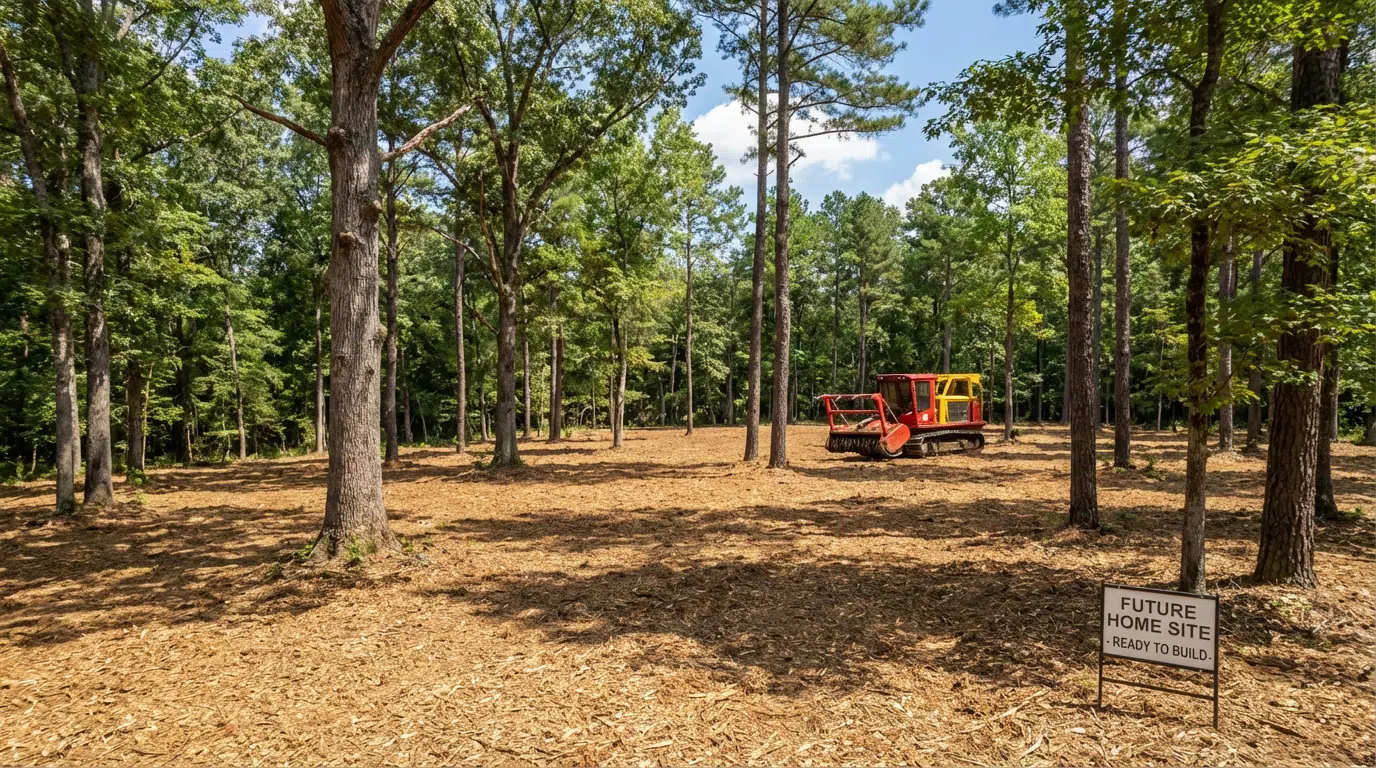
Forestry mulching is a land clearing method that uses specialized equipment to cut, grind, and distribute vegetation across your property in a single pass. Unlike traditional clearing methods that require multiple pieces of equipment and often leave piles of debris, forestry mulching transforms trees, brush, and undergrowth into a protective layer of nutrient-rich mulch.
For new construction projects, this process creates a clean, level building site while preserving the topsoil that’s essential for proper drainage, erosion control, and future landscaping. The mulch layer left behind acts as a natural weed barrier and helps stabilize the soil during the construction phase—critical benefits in the mountainous terrain common throughout North Georgia and the surrounding Tri-State Area.
How Forestry Mulching Works for Building Sites:
The process begins with a site assessment to identify which vegetation needs removal and which trees or features you want to preserve. Using GPS-guided forestry mulching equipment, operators can clear your building footprint, access roads, and utility corridors with precision—removing only what’s necessary while protecting desirable trees and minimizing soil disturbance.
The specialized mulching head grinds vegetation into small pieces that are distributed evenly across the ground. This creates an immediate erosion control layer and eliminates the need for hauling away debris, burning brush piles, or dealing with massive root systems that traditional clearing methods leave behind.
The Benefits of Forestry Mulching for New Construction Site Prep
Faster Project Timeline
Time is money in construction, and forestry mulching significantly accelerates the site preparation phase. Traditional land clearing requires multiple steps: cutting trees, removing stumps, hauling debris, grading, and addressing erosion concerns. Each step requires different equipment and contractors, creating scheduling challenges and extending your timeline.
Forestry mulching consolidates these steps into a single, efficient process. Most residential building sites can be cleared in 1-3 days, depending on size and vegetation density. This means you can move forward with foundation work, utility installation, and construction much faster than with conventional clearing methods.
Cost-Effectiveness Compared to Traditional Clearing
While the upfront cost of forestry mulching may seem comparable to traditional methods, the total project cost is typically lower when you account for all factors:
- No debris removal costs: Traditional clearing generates massive amounts of waste that must be hauled away or burned (where permitted). Forestry mulching eliminates these expenses entirely.
- Reduced equipment needs: Instead of coordinating bulldozers, excavators, trucks, and multiple crews, forestry mulching requires just one specialized machine and operator.
- Less site restoration: Traditional clearing often damages topsoil and requires extensive grading and erosion control measures. Forestry mulching preserves soil structure, reducing restoration costs.
- Faster timeline: Shortened site prep time reduces carrying costs, financing expenses, and project delays.
For property owners in the Tri-State Area building on sloped or challenging terrain, these cost advantages become even more significant.
Minimal Soil Disturbance and Erosion Prevention
In the mountainous regions of North Georgia, Tennessee, and North Carolina, soil erosion is a serious concern during construction. Traditional land clearing with bulldozers and excavators strips away protective vegetation and compacts or displaces topsoil, creating conditions ripe for erosion during rain events.
Forestry mulching takes a fundamentally different approach. The equipment operates on tracks that distribute weight evenly, minimizing soil compaction. The vegetation is ground in place rather than uprooted, keeping the soil structure intact. Most importantly, the mulch layer created during clearing immediately protects the soil from erosion.
This protective mulch layer:
- Absorbs rainfall impact, reducing runoff velocity
- Retains soil moisture, promoting stability
- Prevents sediment from washing into streams or neighboring properties
- Provides organic matter that improves soil health over time
For construction projects near waterways or on steep slopes—common scenarios throughout the region—this erosion control benefit can help you meet environmental regulations and avoid costly remediation.
Environmentally Friendly Approach
Sustainability matters to many property owners, and forestry mulching is the most environmentally responsible land clearing method available for construction sites. The process:
- Keeps all organic material on-site, returning nutrients to the soil
- Eliminates the carbon emissions associated with hauling debris
- Avoids the air quality impacts of burning brush piles
- Preserves beneficial soil microorganisms and mycorrhizal networks
- Allows selective clearing that protects mature trees and wildlife corridors
In areas where building permits require environmental impact considerations, forestry mulching often provides the clearest path to approval.
Better Foundation for Building
The condition of your building site after clearing directly impacts the success of your construction project. Forestry mulching creates an ideal foundation by:
- Maintaining soil integrity and load-bearing capacity
- Providing a stable, level surface for construction access
- Creating natural drainage patterns that prevent water pooling
- Leaving a clean work area free of stumps, roots, and debris piles
- Establishing erosion control before construction disturbance begins
Contractors consistently report that sites prepared with forestry mulching are easier to work on and experience fewer weather-related delays than sites cleared using traditional methods.
When Should You Schedule Forestry Mulching for Your Construction Project?
Timing your land clearing correctly is crucial for project success. Here’s what property owners in the Tri-State Area need to know about scheduling forestry mulching for new construction.
Ideal Timing in the Construction Timeline
Before Permit Application: In some jurisdictions, you may need to show your clearing plan as part of the permit application process. Having a forestry mulching assessment completed before applying can streamline approval.
After Permit Approval, Before Site Work: The optimal time for forestry mulching is immediately after receiving your building permits but before any other site work begins. This ensures you have a clean, stable site ready for:
- Surveying and staking
- Utility installation
- Driveway and access road construction
- Foundation excavation
Allow for Settling: While forestry mulching creates an immediately usable site, allowing 2-4 weeks for the mulch layer to settle and compact naturally before heavy construction traffic can improve site stability.
Seasonal Considerations for the Tri-State Area
Each season offers distinct advantages for forestry mulching in North Georgia and surrounding areas:
Winter (November-February):
- Better visibility with deciduous trees bare
- Frozen ground can support equipment on wet sites
- Lower risk of encountering snakes and ticks
- Often better availability and competitive pricing
- Ground conditions ideal for equipment access
Spring (March-May):
- Optimal time before summer construction season
- Mulch has time to settle before heavy rains
- Cleared sites ready for foundation work in ideal weather
- May require working around wet periods
Summer (June-August):
- Longer working days allow faster completion
- Dry conditions prevent equipment from getting stuck
- Immediate transition to construction possible
- Heat can be challenging for operators and equipment
Fall (September-October):
- Excellent weather conditions for clearing
- Sites ready for winter grading or spring construction
- Lower fire risk than summer months
- Popular season, so schedule early
For most new construction projects in the region, late winter through early spring offers the best combination of favorable conditions and construction timeline alignment.
Coordination with Permits and Inspections
Before scheduling forestry mulching, verify your local requirements:
Fannin County, GA: Regulations vary by property size and proximity to waterways. Contact the county planning department to determine if permits are required for your specific project.
Cherokee County, NC: Land disturbance permits may be required for clearing more than one acre. Erosion control plans are typically necessary.
Polk County, TN: Requirements depend on property location and clearing extent. Check with local authorities before beginning work.
Working with an experienced forestry mulching provider like Big Frog Forestry Mulching ensures you understand and meet all local requirements before clearing begins.
What to Expect During the Forestry Mulching Process
Understanding the forestry mulching process helps you prepare your site and coordinate with your construction timeline effectively.
Initial Site Assessment
The process begins with a comprehensive site evaluation. A professional forestry mulching operator will visit your property to:
- Review your building plans and identify clearing boundaries
- Assess vegetation density, terrain challenges, and access points
- Identify trees or features you want to preserve
- Evaluate soil conditions and potential erosion concerns
- Discuss timeline expectations and project scope
- Provide a detailed quote based on actual site conditions
This assessment typically takes 30-60 minutes and provides the information needed for accurate project planning and pricing.
The Mulching Process
On project day, the forestry mulching equipment arrives and begins systematically clearing your designated area. The specialized mulching head can process:
- Brush and undergrowth of any density
- Trees up to 8 inches in diameter (equipment-dependent)
- Saplings and small vegetation
- Vines and invasive species
The operator works methodically, clearing in patterns that maintain site stability and drainage. Vegetation is ground into mulch pieces typically 2-4 inches in size and distributed evenly across the ground at a depth of 2-4 inches.
GPS Technology for Precision Clearing
Modern forestry mulching equipment can be equipped with GPS guidance systems that provide exceptional precision—a critical advantage for construction sites where exact boundaries matter.
GPS-guided land clearing allows operators to:
- Follow property lines and easement boundaries precisely
- Clear building footprints to exact specifications
- Avoid designated preservation areas
- Create perfectly straight access roads and utility corridors
- Document clearing boundaries for permit compliance
This technology eliminates guesswork and ensures your site is cleared exactly as planned, preventing costly mistakes that could impact your building project.
Post-Mulching Site Preparation
After forestry mulching is complete, your site is immediately ready for the next construction phase. The mulch layer provides:
- A clean, debris-free work surface
- Natural erosion control during subsequent site work
- Weed suppression that keeps the site clear
- Organic matter that will improve soil quality over time
Most contractors can begin work immediately after clearing, though allowing a brief settling period can be beneficial for optimal site conditions.
Forestry Mulching vs. Traditional Land Clearing for Construction
Understanding the differences between clearing methods helps you make an informed decision for your building project.
| Factor | Forestry Mulching | Traditional Clearing |
|---|---|---|
| Equipment Required | Single forestry mulcher | Bulldozer, excavator, trucks, possibly chipper |
| Timeline | 1-3 days for typical residential site | 5-10 days or more for same site |
| Debris Removal | None needed—mulched on-site | Hauling required or burn piles |
| Soil Disturbance | Minimal—topsoil preserved | Significant—often removes topsoil |
| Erosion Control | Immediate—mulch layer protects soil | Requires additional measures |
| Stump Removal | Not necessary—ground below grade | Required separately—adds cost |
| Site Accessibility | Track equipment works on slopes | May require extensive grading |
| Environmental Impact | Low—organic matter stays on-site | Higher—debris hauling, burning |
| Cost | $500-$2,500 per acre (typical) | Often higher when all factors included |
| Final Site Condition | Clean, level, erosion-protected | Often requires grading, restoration |
For most new construction projects in the Tri-State Area’s varied terrain, forestry mulching offers superior results at competitive or lower total costs.
What Happens After Forestry Mulching? Next Steps in Your Construction Project
Once your site is cleared, you’re ready to move forward with your building project efficiently.
Site Inspection and Approval
After forestry mulching, schedule any required inspections:
- Erosion control inspection: Verify that mulch layer and drainage meet requirements
- Clearing boundary verification: Confirm that clearing matches approved plans
- Environmental compliance: Document that sensitive areas were protected as specified
Having these inspections completed promptly keeps your project on schedule and prevents delays later in the construction process.
Grading and Final Preparation
Depending on your building plans, additional site preparation may include:
- Finish grading: Fine-tuning elevations for drainage and foundation placement
- Driveway installation: Creating access for construction vehicles and equipment
- Utility installation: Running water, sewer, electric, and other services to the building site
- Temporary erosion control: Adding silt fencing or additional measures if required
The stable, clean site created by forestry mulching makes all of these subsequent steps easier and more efficient.
Maintaining Cleared Areas Before Construction Begins
If there’s a gap between clearing and construction, simple maintenance keeps your site in optimal condition:
- Monitor erosion: Check after heavy rains and add additional mulch if needed
- Control regrowth: Forestry mulching significantly suppresses regrowth, but occasional spot treatment may be necessary for aggressive species
- Maintain access: Keep entry points clear for equipment and deliveries
The mulch layer created during forestry mulching provides excellent protection during this interim period, far superior to bare soil left by traditional clearing methods.
Why Choose Professional Forestry Mulching for Your Construction Site
While some property owners consider DIY clearing or hiring general contractors with basic equipment, professional forestry mulching offers distinct advantages for new construction projects.
Equipment Advantages
Professional forestry mulching equipment represents a significant investment—typically $200,000-$400,000 for high-quality machines. This equipment provides:
- Power and efficiency: Purpose-built mulching heads that process vegetation quickly
- Precision control: GPS guidance and operator skill for exact clearing boundaries
- Safety features: Roll-over protection, enclosed cabs, and proper safety systems
- Track systems: Low ground pressure that minimizes soil compaction and allows work on slopes
Attempting to clear land with inadequate equipment often results in poor outcomes, extended timelines, and potential safety hazards.
Experience Matters
Experienced forestry mulching operators understand:
- How to read terrain and anticipate drainage issues
- Which vegetation patterns indicate underlying problems
- How to preserve desirable features while clearing efficiently
- Local regulations and permit requirements
- How to coordinate with construction timelines and other contractors
This expertise ensures your site is cleared correctly the first time, avoiding costly mistakes that could delay your building project.
Safety Considerations
Land clearing involves significant safety risks. Professional forestry mulching operators:
- Carry proper liability and workers’ compensation insurance
- Follow OSHA safety protocols and industry best practices
- Use equipment with appropriate safety features and certifications
- Understand utility location requirements and work safely around power lines, gas lines, and other infrastructure
Protecting yourself from liability and ensuring safe site preparation is worth the investment in professional services.
For property owners throughout the Tri-State Area preparing for new construction, Big Frog Forestry Mulching’s GPS-guided land clearing services provide the precision, efficiency, and expertise needed for successful site preparation.
Making the Right Choice for Your New Construction Project
Preparing your land for new construction is a critical first step that influences every aspect of your building project. Forestry mulching offers property owners in North Georgia, Tennessee, and North Carolina a superior site preparation method that combines speed, cost-effectiveness, environmental responsibility, and optimal site conditions.
By choosing forestry mulching for your construction site preparation, you benefit from:
- Faster timelines that get your project moving quickly
- Cost savings compared to traditional multi-step clearing methods
- Soil preservation that protects your property’s long-term health
- Erosion control that prevents problems during and after construction
- Environmental benefits that minimize your project’s ecological impact
- A clean, stable building site that contractors appreciate
Whether you’re building your dream home in the Blue Ridge Mountains, developing commercial property in McCaysville, or preparing a building site anywhere in the Tri-State Area, understanding your land clearing options helps you make informed decisions that set your project up for success.
Ready to prepare your building site with professional forestry mulching? The team at Big Frog Forestry Mulching has helped countless property owners throughout North Georgia and the Tri-State Area prepare their land for successful construction projects. We’d be happy to assess your site, answer your questions, and provide a detailed quote for your project.
Call us at (706) 851-3524 or visit our website to request a free consultation. Let’s discuss how forestry mulching can streamline your construction site preparation and set the foundation for your building success.

0 Comments